
Full specifications
Vaquita: Ocean Spirit 43, Woods Design (UK), built by Coplan Boats, Walkerville, South Africa. Hull ID OS43-7. SAMSA Category A, certified for unrestricted offshore operation. Currently moored at Durban Marina.
Vessel particulars
| LOA | 12.9 m (43 ft) |
|---|---|
| Beam | 7.85 m |
| Draft | 1.25 m |
| Hull ID | OS43-7 |
| Fuel capacity | 2 × 1 250 L |
| Fresh water | 2 × 800 L |
| Black water | 2 × 75 L |
Propulsion and steering
| Engines | 2 × Yanmar 4JH57, 4-stroke naturally aspirated diesel, 57 hp each, mid-mounted |
|---|---|
| Gearboxes | 2.63:1 reduction, flexible coupling |
| Shafts | 35 mm stainless steel, through thrust bearing and Vetus double-lip seal |
| Bearings | Twin cutlass (stern tube + P-bracket) |
| Propellers | 20-inch three-blade |
| Steering | Twin rudders on skegs, 35 mm flanged stocks, Vesconite bearings, Vetus hydraulic rams (port and starboard independent) |
| Max speed | 9.5 knots |
| Cruise speed | 8 knots |
| Survey speed | 5.5 knots |
Electrical and solar
| System | 12 V DC and 220 V AC, redundant port and starboard sides |
|---|---|
| Alternators | 2 × 150 A (3 600 W), engine-driven |
| Starter / engine batteries | 2 × Voltec 12 V 100 Ah deep-cycle |
| House batteries | 8 × 1.2 kWh Hubble lithium |
| Solar array | 6 × 420 W TRINA monocrystalline (2.52 kW combined) |
| Solar controllers | 2 × Victron SmartSolar MPPT 150/85 |
| Inverters | 2 × Victron MultiPlus II 3 kVA, parallel-capable |
| Bilge pumps | 2 × 12 V automatic per hull + 1 manual per engine compartment |
Navigation electronics
| VHF radio | Garmin VHF 315i |
|---|---|
| Chart plotter (12") | Garmin GPSMAP 8412xsv with G3V East Africa charts |
| Radar | Garmin GMR 18xHD |
| Sonar module | Garmin GSD 26 |
| CHIRP transducer | Garmin Airmar B275LHW, 12-pin, 1 kW |
| Smart transducer | Garmin Airmar DST810 |
| Autopilot | Garmin Reactor 40 hydraulic, SmartPump, GFR10 feedback |
| Long range receiver | ICOM 802 HF/SSB Marine Radio |
| AIS transceiver | Garmin 800 Blackbox AIS transceiver |
| Network | Garmin NMEA 2000 |
Survey equipment
- Transducer pole system
- Rear stainless-steel support structure with a thick-walled 70 mm pole, adjustable from 200 mm to 1000 mm below the hull and propellers. Removable base plate accepts alternative bolt patterns during mobilisation. Configured for sub-bottom profilers, multibeam sonar (Reson 7101 or equivalent), and side-scan systems.
- Electronic winch
- Runva 9500 lbs winch with 200 m of 4 mm dyneema line (1 300 kg breaking strain). Raises hydrographic equipment between sites, and can also tow side-beam, magnetometer, sampling and plankton-net rigs onto the rear scoop.
- Hydraulic winch
- Stainless-steel winch with 200 m of 6 mm stainless steel cable (3 200 kg breaking strain). Line runs through a swivelling stainless-steel hoist projecting 1 m beyond the forward beam for grab and sediment sampling. Motor produces 1 000 daNm of torque, lifts 1 600 kg comfortably. Speed 50 to 60 m/min over the first 100 m of line. Hydraulic brake holds the line when the motor is neutral.
- Hydraulic system
- 32 cm³/rev displacement pump, 30 L/min flow at 180 bar with the engine idling at 1 000 rpm. Driven off the port engine via double belt and electromagnetic clutch (engaged only when winching at sea). 90 L hydraulic-fluid reservoir.
- Wash-down
- High-pressure saltwater hose in the port-side wet locker for washing sediment samples and grab cradle trays, and a freshwater shower is conveniently located on the aft port-side sugar scoop providing a practical rinse-off station.
General arrangement
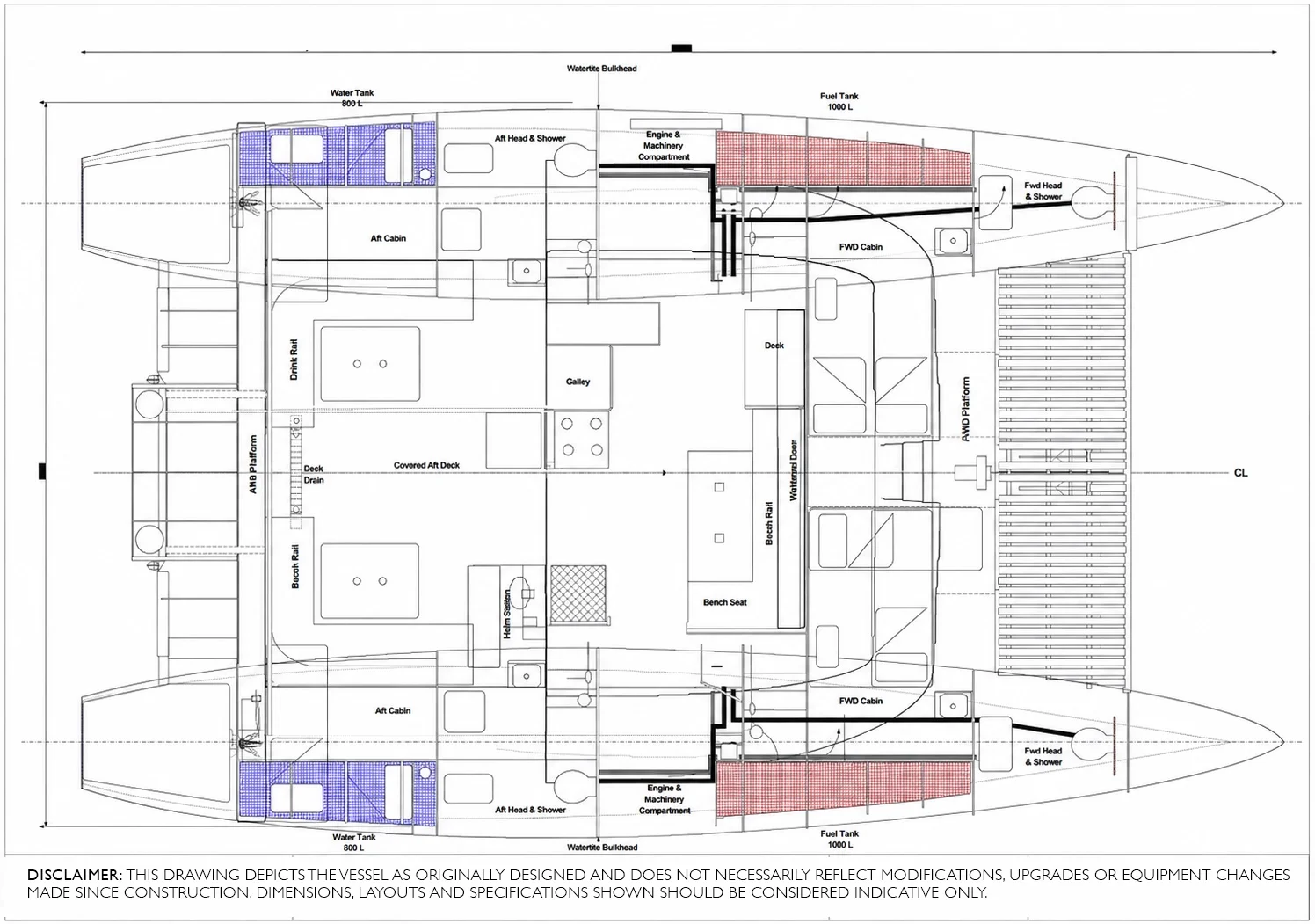
Accommodation and deck
- Cabins
- Accommodation is provided in four well-appointed ensuite cabins, offering comfortable berthing for both crew and survey personnel. The forward section features two spacious double cabins, while two twin-berth cabins are located aft. Each cabin is equipped with a private ensuite bathroom comprising a hand basin, shower, and electric toilet, and benefits from a porthole that provides natural light and ventilation, creating a bright and comfortable onboard living environment.
- Saloon
- The main saloon features comfortable L-shaped seating for six around a central dining table, creating an inviting space for meals, meetings, or mission planning. Dedicated chart tables are positioned on both the port and starboard sides, each complemented by integrated storage cupboards below for charts, equipment, and operational materials. Additional storage is provided through a galley-side cupboard and under-bench compartments, maximising practicality without compromising comfort. A TV monitor allows crew and survey personnel to view navigation and survey data directly from the helm station plotter, while also serving as an entertainment system during downtime.
- Galley
- Centrally located for convenient access from both the forward accommodation and aft working areas, the galley is designed for efficient onboard living during extended offshore operations. Facilities include a double stainless-steel sink with hot and cold pressurised water, a double-door inverter-powered fridge/freezer, a gas stove, and a microwave oven, providing all the essentials for comfortable meal preparation at sea.
- Aft deck
The spacious covered aft deck is designed as a versatile working and social area, featuring L-shaped bench seating with tables on both the port and starboard sides. These areas provide generous workspace, integrated power outlets, and dedicated storage for sample bottles and survey equipment. The elevated helm station, positioned to starboard, offers commanding visibility over the vessel and surrounding work area, enhancing operational awareness during survey activities.
Additional aft deck amenities include port and starboard escape hatches, a gas braai (grill), freshwater sink, and live bait well. A freshwater shower is conveniently located on the port-side sugar scoop, providing a practical rinse-off station for personnel and equipment following diving, swimming, or deck operations. A dedicated pole-and-winch deployment system further enhances the vessel's survey capability, enabling the safe and efficient launch and recovery of hydrographic and oceanographic equipment.
- Fore deck
The expansive foredeck is configured to support both operational efficiency and extended offshore missions. Seven dedicated compartments are strategically integrated into the deck layout, including port and starboard rope lockers, a central chain locker housing the windlass and anchor chain, two wet lockers, and port and starboard ventilation hatches that provide natural airflow and cooling to the interior accommodation spaces.
To support survey and sampling operations, the foredeck is equipped with a hydraulic winch and a dedicated locker housing the hydraulic motor. The system interfaces with a forward-mounted hoist, enabling the deployment and recovery of grab samplers and other survey equipment. The port-side wet locker incorporates a high-pressure seawater washdown hose, providing a convenient means of rinsing the deck, equipment, and sediment samples during field operations.
- Laundry
- Combined washing machine and spin dryer in the starboard companionway.
Safety
- Classification
- SAMSA Category A, the highest operational classification under South African small-vessel regulations. Certified for unrestricted offshore operation, including transoceanic and deep-sea voyages.
- Life raft
- 12-person, stern-box mounted
- Fire extinguishers
- 1.5 kg in each cabin, 2.5 kg in the galley, automatic extinguisher in each engine room
- Other
- Full SAMSA Category A safety inventory
Construction
| Hulls (below chine) | GRP with biaxial glass layup |
|---|---|
| Hulls (above chine) | GRP biaxial glass with core |
| Bridge deck | GRP biaxial + Nida core, 150 mm high on a 9 mm marine-ply matrix (350 × 350 mm) |
| Aft deck | GRP with 75 mm honeycomb core, 120 mm high on a 9 mm marine-ply matrix |
| Lower bulkheads | 15 mm marine ply encapsulated in GRP, bonded to hull with woven roving and chopstrand |
| Upper bulkheads | GRP foam-cored or 16 mm marine ply |
| Lateral beams | 20 mm marine ply / GRP biaxial |
| Interior finish | Polyester flowcoat |
| Exterior above waterline | 2K polyurethane |
| Below waterline | Epoxy primer over epoxy moisture barrier, black antifouling |
| Glazing | Toughened safety glass throughout |